Levels of child undernutrition have been dropping in Bangladesh since 1996, but substantial challenges still remain
Measuring progress against the NPAN2 target and WHO public health ‘critical’ thresholds
Underweight children <5 years
BDHS, WHO Algorithm was applied to convert from NCHS to WHO standards
Stunted children <5 years
Wasted children <5 years
There is a high prevalence of all types of undernutrition throughout Bangladesh
Sylhet is the worst affected Division in all three indicators of undernutrition
Underweight (0-59 months)
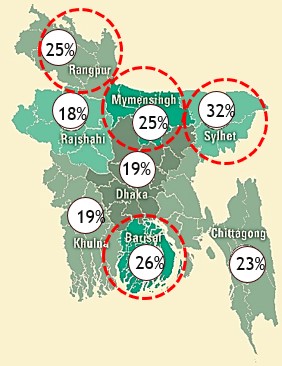
Data Source : BDHS (2022)
Stunting (0-59 months)
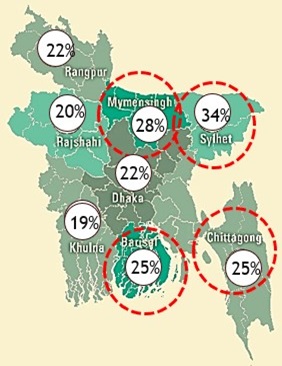
Data Source : BDHS (2022)
Wasting (0-59 months)
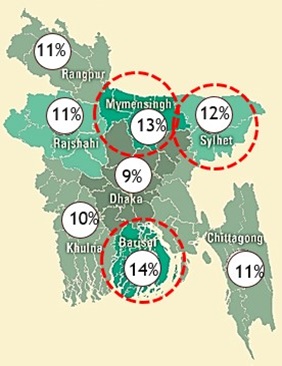
Data Source : BDHS (2022)
Nationally representative data (2014) show that overall indicators of economic growth and household wealth are not strongly related to improved nutrition
One in every four children is stunted even in the highest wealth quintile households
Undernutrition in children under 5 years old by household wealth
- While over half of the under 5 children in the poorest household wealth quintile are stunted, undernutrition is not restricted to the poor
- This situation reflects the underlying multi-dimensional causes of undernutrition
Undernutrition is common among adult women in Bangladesh
There are marked regional variations and a strong relationship with food insecurity
Undernutrition is common among adult women in Bangladesh
Inadequate height = shorter than 145cm
Low Body Mass Index = BMI (weight kgs/height m2) less than 18.5
HFIAS: Household Food Insecurity Access Scale
FDS: Food Deficit Scale
FCS: Food Consumption Score
DD: Diet Diversity
FSNSP 2012 report
Undernutrition in adult woman by food consumption and diet diversity
Undernutrition in adult woman by food consumption and diet diversity
Undernutrition is also common among adolescent girls in Bangladesh
Similar regional variations but weaker relationship with food security
Undernutrition in adolescent girls (10-18 years)
Inadequate height = shorter than 145cm
Low Body Mass Index = BMI (weight kgs/height m2) less than 18.5
HFIAS: Household Food Insecurity Access Scale
FDS: Food Deficit Scale
FCS: Food Consumption Score
DD: Diet Diversity
FSNSP 2012 report
Undernutrition in adolescent girls by food consumption and diet diversity
Undernutrition in adolescent girls by food consumption and diet diversity
Although gradually decreasing, levels of anaemia still remain high: just over a quarter of all non-pregnant and non-lactating women are anaemic
Anaemia among children and women represents an intergenerational threat to health
Anaemia
- Reduced immunity
- Increased risk of maternal mortality
- Increased risk of perinatal mortality
- Intrauterine growth retardation
- Premature births
- Reduced cognitive development
- Reduced psychomotor development
- Reduced ability to concentrate
- Reduced scholastic performance
- Fatigue and reduced productivity
- Increased economic burden
Consequences of anaemia:
Iodine deficiency remains a serious problem despite the existence of mandatory Universal Salt Iodization and high usage of Iodized salt
4 in 10 school-aged child are iodine deficient. 57% of households use adequately iodized salt
Prevalence of Iodine Deficiency
Coverage of households with equately iodized salt
Are economic growth and poverty reduction related to undernutrition?
Poverty and stunting have reduced similarly but not as rapidly as economic growth
Bangladesh Demographic and Health Survey (BDHS)
Eliminating child marriage is a priority and there has been some reduction
But over half of all women in rural areas are married before their 18th birthday
Percentage of female teenage (15-19 years) married population by administrative divisions 2011
Child Equity Atlas: BBS-BIDS-UNICEF 2013
BDHS 2011
BDHS 2011
Woman age 20-24 years who were first married before age 18, and,15 years old
Marriage before the age of 18 is prohibited by law
It is also a violation of children’s and women's rights:
- Convention on the Rights of the Child, CRC
- Convention of Elimination of all Forms of Discrimination Against Women, CEDAW
Women tend to marry later if they continue education into secondary level
Child marriage exists across the country and is higher in rural areas
Median age of first marriage of woman of age 20-24 based on education attainment (2014)
Median age of first marriage of woman of age 20-24
Levels of mother’s education are associated with levels of undernutrition
Childhood stunting and wasting reduce significantly with increasing levels of mother’s education
Mother's education and child undernutrition, 2014
BDHS 2011
Child Equity Atlas: BBS-BIDS-UNICEF 2013
Child Equity Atlas: BBS-BIDS-UNICEF 2013
Educational attainment of married and unmarried young woman in Bangladesh, 2011
Overall, rates for exclusive breastfeeding have risen but early initiation of breastfeeding has not changed significantly
By 4-5 months old, only just over a third of children are still exclusively breastfed
Excusive breastfeeding
Initiation of breastfeeding/ 1hour of birth
Breastfeeding stutus of 4-5 months old children in 2014
Mother’s education is associated with infant and young child feeding practices
The relationship is strongest for proper complementary feeding practices
Median duration of EBF in months and mother's education (2014)
Proper complementary feeding for children 6-23 months education (2014)
About half of all children do not receive complementary foods at the right time
15% of children receive complementary foods too early and nearly 40% start too late
Complemantry feeding practice (Children 6-23 months old)
Complemantry feeding practice (Children 6-23 months old)
Levels of child undernutrition are strongly related to IYCF practices
Geographical comparison highlights this relationship
IYCF practice and stunting
IYCF practice and wasting
About half of all children do not receive complementary foods at the right time
15% of children receive complementary foods too early and nearly 40% start too late
Complemantry feeding practice (Children 6-23 months old)
Complemantry feeding practice (Children 6-23 months old)
Levels of maternal undernutrition are decreasing slightly but still remain high
The same pattern applies to antenatal care coverage
Meternal undernutrition (15-49 years ever married woman)
ANC Coverage
A quarter of all pregnant women are undernourished (using MUAC)
There are some geographical variations
Woman malnourished by trimester and pregnancy status
Undernutrition among pregnant woman
Safe drinking water and sanitation
Population with access to improved sanitation is improving, particularly in rural areas
- Access to an improved source of drinking water is universal (99%)
- Most common sources of drinking water are tube well or borehole
- For 71% of households, drinking water is within the premises
Population with access to improved, not shared, sanitation facilities
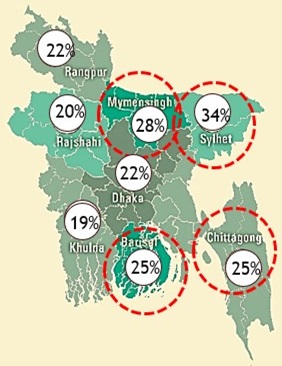
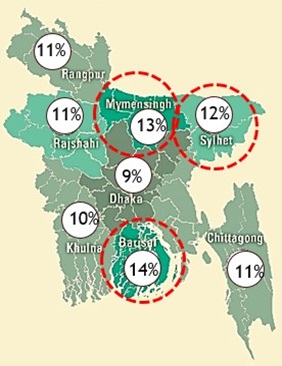
Poor and borderline food consumption levels are widespread across the country
But the relationship with undernutrition is weak
Poor or borderline food consumption
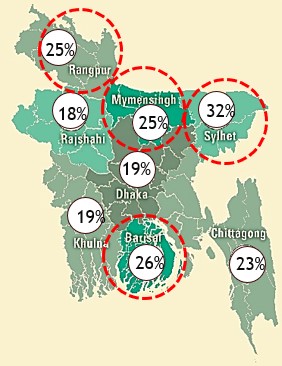
Stunting (0-59 months) Chronic Malnutrition
Wasting (0-59 months) Acute Malnutrition
Over half of all households are food insecure, up to nearly 60% in rural areas
There is a strong relationship with stunting across Divisions
HFIAS and Stunting
Household food insecurity drops with income but even the wealthiest quintile has significant food insecurity
Food insecure households have more stunted children
HFIAS and stunting according to household wealth
Household food insicurity and stunting